The moment everything gets complicated
You have just sold a chest of drawers on a second-hand platform. Up until now, everything was going fast: two photos, one listing, three messages. Then the buyer lives on the other side of the country, and the nature of the conversation changes. You have to find a box, except that there is no box the size of a chest of drawers. So you disassemble it, put the screws in a bag that you will lose, and look for bubble wrap on a Sunday night.
Next, you have to measure: actual weight, volumetric weight, the sum of the three dimensions. Each carrier has its own pricing grid and its own thresholds beyond which the item "no longer fits the offer." You compare three sites, you don't understand why the same item costs three different prices, and you end up choosing at random.
Finally, you have to carry it. To the car, then from the parking lot to the drop-off point, where you discover that the merchant refuses this size format. And over the following days, one question plays on a loop: will it arrive in one piece?
This identical scenario plays out for a bicycle you are selling, a mirror inherited from a grandmother, a TV you are leaving to a friend, a console sold online, a light fixture found at a flea market, a washing machine you no longer use. The same conclusion every time: shipping an everyday object was never designed for objects. It was designed for parcels.
Existing networks are tailored for parcels, not for objects
This is not a trial. Parcel networks do very well what they were built for: mass transporting rectangular, stackable packages of consistent size and weight. Their entire chain relies on this regularity: sorting belts, bins, delivery routes, drop-off points. An unpackaged object, asymmetrical, heavy on one side and fragile on the other, does not fit in. Hence the packaging: its role is not just to protect your object, it is to transform it into a parcel so that it becomes acceptable to the network. You are the one doing this boxing work, instead of the carrier.
The alternatives each have their limits. Platforms that connect you with a private carrier work on a case-by-case basis: publishing an ad, waiting for offers, negotiating a schedule, relying on someone else's planned trips. Palletized transport is designed for professional flows, with packaging that you cannot easily improvise at home. And renting a utility vehicle solves the problem by shifting it: you become the carrier.
There is one last option left, the one that wins most often: writing "local pickup only" in the listing. It is convenient, but it is a compromise: it divides the number of buyers, lowers the price, and dooms perfectly usable objects to never find a buyer.
From photo to recipient's doorstep
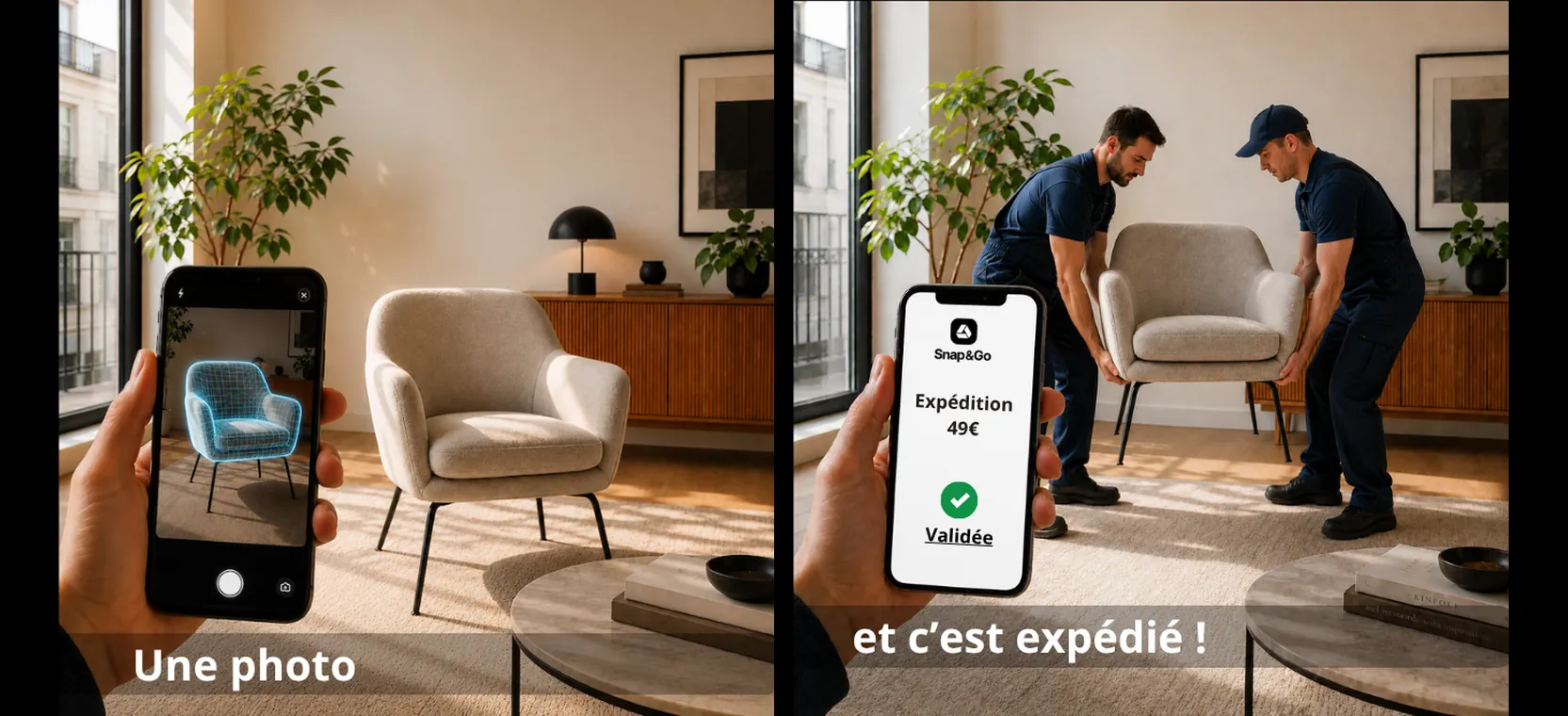
Snap&Go starts from a simple observation: if the problem comes from the packaging, we need to eliminate it, not learn how to do it better. The process takes place in six steps, only one of which requires an effort on your part.
You take a photo. In the application, you photograph the object as it is, where it is. Not disassembled, not wrapped, not protected. The chest of drawers remains a chest of drawers.
Artificial intelligence reads the object. It analyzes its dimensions, fragility, value, and destination, then determines the ideal transport conditions. It does the qualification work that you used to do by hand.
A price is displayed. Immediately, in the application, with no quotes to request or pricing grids to decipher.
You choose a time slot. Pickup is scheduled from the application, at a time that suits you.
A dedicated driver comes to your home. They pick up the unpackaged object, directly from your home. Nothing to prepare, nothing to carry down, nothing to load.
You track the delivery. Pickup confirmed, in transit, delivered: each step is displayed, for you as well as for your recipient, up to final delivery in France.
This is what smart delivery is about: not faster transport, but a decision made by analysis rather than by the sender.
One photo is enough: the box ceases to be your problem
This first pillar resolves the longest chore in the chain. Looking for packaging of the right size costs time, money, and material made to be thrown away a few days later. By photographing the object as it is, you eliminate the search for a box, preventive disassembly, and the hour spent wrapping bubble wrap.
Instant AI: qualification moves from you to the machine
Knowing how to send an object normally requires answering a series of technical questions: how much does it weigh, what are its dimensions, is it fragile, what is it worth? The Snap&Go AI analyzes these characteristics to determine the most suitable transport solution and generate your quote. You no longer translate your object into a form.
Home furniture pickup and delivery: nobody carries anything
The parcel drop-off point imposes two constraints that are rarely mentioned: you have to go there, and the object must fit. A Snap&Go driver comes to pick up the object directly from your home, unpackaged, without you having to go anywhere or prepare anything. For a chest of drawers or a washing machine, this single point changes the feasibility of sending it: home furniture delivery becomes possible without a rented truck or recruited neighbors.
Ad valorem insurance: covering what the object is worth
In traditional networks, compensation is most often flat-rate and calculated by weight: a light and valuable object is therefore poorly protected by design. Every Snap&Go shipment is covered by insurance calculated on the declared value of the object, from pickup to final delivery. For sending a fragile object, mirror, painting, or antique light fixture, this is the difference between symbolic compensation and coverage that corresponds to the actual loss.
Real-time tracking: the end of silent anxiety
The stress of shipping does not just come from the risk: it comes from the silence. From the application, you track every step, from confirmed pickup to transit and delivery, and your recipient is informed at the same key moments. No need to follow up with anyone to know where the bike or TV is.
Responsible logistics: the best packaging is the one that is not manufactured
The cardboard and plastic wrap of a shipment have a useful life of a few days, while their environmental cost is incurred right from production. By eliminating unnecessary packaging and optimizing collection routes, Snap&Go reduces the carbon footprint of each shipment.
Shipping an object: before / with Snap&Go
Step | Before | With Snap&Go |
|---|---|---|
Finding packaging | Right size box, wrap, padding, disassembly | None: the object leaves as it is |
Measuring and weighing | Tape measure, scale, volumetric weight | One photo; AI analyzes dimensions and fragility |
Choosing a carrier | Comparing pricing grids and their thresholds | The suitable solution is determined automatically |
Moving | Carrying to the car, then to the drop-off point | A driver comes to pick up the object from your home |
Knowing where the object is | Tracking that is sometimes silent for several days | Pickup confirmed, in transit, delivered |
Being covered in case of breakage | Compensation often flat-rate, by weight | Ad valorem insurance, on the declared value |
Waste generated | Cardboard, bubble wrap, tape, padding to throw away | No packaging manufactured, so nothing to throw away |
To go further, two articles extend the subject: how to ship furniture or decor without preparing anything and the role of transport in the circular economy.
FAQ
How does Snap&Go work?
You photograph your object in the application, as it is. Artificial intelligence analyzes its dimensions, fragility, value, and destination, then determines the ideal transport condition and displays a price. You then choose a pickup slot, a dedicated driver comes to pick up the object from your home, and you track the delivery in real-time.
Do you really need to pack your item?
No. That is the very principle of the service: the object is collected unpackaged, from your home. You have no box to find, no bubble wrap to buy, and no preventive disassembly to plan. The photo shows the object in its actual state, and it is based on this state that the transport condition is determined.
What objects can be sent with Snap&Go?
The service covers furniture and sofas, paintings and mirrors, bicycles, musical instruments, household appliances and TVs, collectibles, light fixtures, and game consoles. In practice, if you are unsure, the photo is the fastest answer: the analysis is done on the object itself, within the application.
How do I know the price of my shipment?
The price is displayed in the application immediately after the photo analysis. There is no quote to request by email, no tariff grid to interpret, and no dimensions to enter by hand. Since it depends on the characteristics of the object and its destination, the photo triggers the calculation.
Does Snap&Go deliver everywhere in France?
Snap&Go organizes delivery in France, from end to end: from pickup at your home to delivery to the recipient. The application is available on iOS and Android. For a specific address, the request made from the application will give you the most reliable answer at the time of sending.
One photo, and you're good to go
An object should not end up in the basement because shipping it took too much effort. The rest is just one gesture away: download the application on snapandgo.app, photograph your object, and let it go.